Every year, millions of graduates across India prepare for one thing: a bank job. Not an IT job. Not a startup role. Not a government teaching position. A bank job. And every year, that number keeps climbing — because in a country where stability matters more than stock options for most families, the banking sector continues to offer something few other careers can match.
If you have been wondering whether banking is the right career path for you, this guide will give you every answer you need — from the roles available, to eligibility criteria, to what you actually take home each month. No hype, no vague promises. Just the facts you need to make a confident, informed decision.
Why Banking Remains One of India’s Most Sought-After Career Sectors
Before diving into specifics, it is worth understanding why bank jobs continue to attract crores of applicants year after year, even as private tech companies, startups, and gig economy roles explode in popularity.

The answer comes down to four pillars: stability, salary, benefits, and social value.
A public sector bank employee does not receive a layoff email at 6 PM on a Friday. Their salary arrives on the 1st of every month — always. Medical coverage extends to their family. A pension scheme ensures retirement does not feel like stepping off a cliff into uncertainty. And in much of India, a government bank job still carries social prestige that no private sector title can easily match.
When you add together basic pay, Dearness Allowance (DA), House Rent Allowance (HRA), transport allowance, special allowance, and medical benefits, the total compensation package of a Probationary Officer in a public sector bank can easily reach ₹10–12 lakh per annum in effective value — significantly higher than the headline basic pay figures that often get quoted out of context.
The competition is fierce, yes. But the reward is real and lasting.
Types of Banking Jobs in India
“Bank job” means different things depending on who says it. Before preparing for any exam or submitting any application, it is essential to understand the landscape of roles available.
1. Clerk / Customer Service Associate (CSA)
The entry-level gateway into public sector banking. Clerks handle cash transactions, process account openings, manage KYC documentation, and serve as the primary customer-facing staff at branch level. The role is structured, predictable, and process-driven. For someone fresh out of college seeking a stable start, it remains one of the most accessible and rewarding entry points into the sector.
2. Probationary Officer (PO)
The most aspirational role for most banking exam candidates. POs supervise branch operations, approve loans, manage teams, and handle decision-making responsibilities. The probation period typically lasts two years, during which you rotate across departments and functions. After confirmation, you hold full officer status with a significantly higher salary and a realistic roadmap to becoming a Branch Manager within 8 to 10 years of service.
3. Specialist Officer (SO)
Banks also recruit specialists in IT, Law, HR, Marketing, Agriculture, and Finance. These roles require subject-specific qualifications — an engineering or computer science degree for IT Officer, an LLB for Legal Officer, an MBA for Marketing Officer, and so on. Competition for specialist roles is narrower because the eligibility pool is smaller, making these an excellent strategic choice for candidates with relevant postgraduate or professional qualifications.
4. Regional Rural Bank (RRB) Officers and Assistants
RRBs serve rural and semi-urban populations across India and are jointly owned by the Central Government, State Governments, and a sponsor bank. IBPS conducts separate exams (IBPS RRB) for Officer Scale I, II, III, and Office Assistant posts. These roles offer a strong foundation and a meaningful career for those comfortable working outside metropolitan centres.
5. RBI Grade B and RBI Assistant
The Reserve Bank of India conducts its own independent recruitment. RBI Grade B is considered one of the most prestigious roles in Indian banking — a highly competitive exam with limited seats, but one that places you at the apex of the monetary system. RBI Assistant roles are clerical in nature, comparable to PSB clerk positions but within the central bank’s distinct ecosystem.
6. Private Sector Bank Roles
HDFC, ICICI, Axis, Kotak, and other private banks recruit through campus placements, walk-in interviews, and direct applications. Roles include Relationship Manager, Credit Analyst, Wealth Advisor, Operations Executive, and Branch Sales Officer. These positions do not require banking entrance exams. Starting salaries can sometimes exceed public sector equivalents, but job security, work-life balance, and benefits are structured very differently.
Latest Banking Job Notifications in 2026
The banking recruitment calendar in 2026 has already seen several major announcements. Here are some of the key openings either active or recently notified:

Punjab & Sind Bank – Local Bank Officer (LBO) Recruitment 2026
- Vacancies: 1,000 posts across 17 states and Union Territories
- Post: Local Bank Officer (JMGS-I)
- Application Window: 31 March 2026 to 20 April 2026
- Key Requirement: Minimum 18 months of officer-level experience in a Scheduled Commercial Bank or Regional Rural Bank
- Salary: ₹48,480 to ₹85,920 per month (plus DA, HRA, and other allowances)
- States Covered: Uttar Pradesh, Punjab, Gujarat, Maharashtra, Tamil Nadu, West Bengal, and more
IBPS – Multiple Banks (2025–26 Cycle)
- Over 15,700 clerk vacancies released in a single IBPS Clerk notification in the 2025 cycle
- IBPS PO recruitment for 5,208 Probationary Officer posts
- IBPS SO (Specialist Officer) exams across IT, Law, Marketing, HR, and Agriculture verticals
- IBPS RRB recruitment covering Officer Scale I, II, and III as well as Office Assistants
SBI – Specialist Cadre Officers
- SBI continues to release Specialist Cadre Officer notifications independently, with openings for Deputy Managers, Credit Officers, IT Officers, and CA (Chartered Accountant) roles
- Application windows have been open across February and March 2026
Central Bank of India
- 350 vacancies announced in January 2026 for Foreign Exchange and Marketing specialists under MMGS-III and JMGS-I pay scales
Note: Always verify current status, dates, and vacancy counts directly on official bank websites or the IBPS portal (ibps.in) and RBI’s careers page (rbi.org.in), as recruitment calendars update frequently.
Eligibility Criteria for Banking Jobs in India
Understanding eligibility before investing months of preparation is non-negotiable. Here is a consolidated breakdown for the most common public sector bank roles.
Educational Qualification
| Role | Minimum Qualification |
|---|---|
| Bank Clerk / CSA | Bachelor’s degree (any discipline) from a recognised university |
| Probationary Officer | Bachelor’s degree (any discipline) from a recognised university |
| IT Specialist Officer | B.E./B.Tech in CS, IT, or Electronics |
| Law Officer | LLB (3-year or 5-year integrated) |
| HR/Personnel Officer | Graduate + MBA/PGDM in HR |
| Marketing Officer | Graduate + MBA/PGDM in Marketing |
| Agriculture Field Officer | B.Sc. Agriculture or allied disciplines |
| RBI Grade B | Bachelor’s degree with minimum 60% marks (50% for SC/ST/PWD) |
| RBI Assistant | Bachelor’s degree (any discipline) |
For most clerk and PO positions, the subject of your graduation does not matter. Arts, commerce, science, engineering — all are accepted equally. The form cares only that you hold a degree from a recognised institution.
Age Limits (General Category)
| Role | Minimum Age | Maximum Age |
|---|---|---|
| Bank Clerk | 20 years | 28 years |
| Probationary Officer | 20 years | 30 years |
| Specialist Officer | 20 years | 30 years (varies by post) |
| RBI Grade B | 21 years | 30 years |
| RBI Assistant | 20 years | 28 years |
Age relaxations are applicable as follows:
- SC/ST candidates: 5 years
- OBC (Non-Creamy Layer): 3 years
- PWD candidates: 10 years
- Ex-Servicemen: 3 years (after deducting military service from age)
- Widows/Divorced women (not remarried): 9 years in some categories
Age limits are strictly enforced. If you are approaching the upper age limit under the General category, prioritise your preparation immediately.
Nationality
Candidates must be Indian citizens. Certain categories of citizens from Nepal, Bhutan, or persons of Indian origin with intent to permanently settle in India may also be eligible — refer to individual bank notifications for specifics.
Computer Literacy
While not always a formal eligibility criterion at the application stage, practical computer proficiency is essential for every modern banking role. All public sector banks operate on Core Banking Solutions (CBS) platforms. Comfort with basic spreadsheet use, internet navigation, and fast typing speed is expected from Day 1.
The Major Exams – Which One Should You Target?
Banking recruitment in India is not one monolithic exam. It is a collection of separate examinations conducted by different bodies, each with its own calendar, syllabus, and selection process. Understanding this ecosystem is critical.
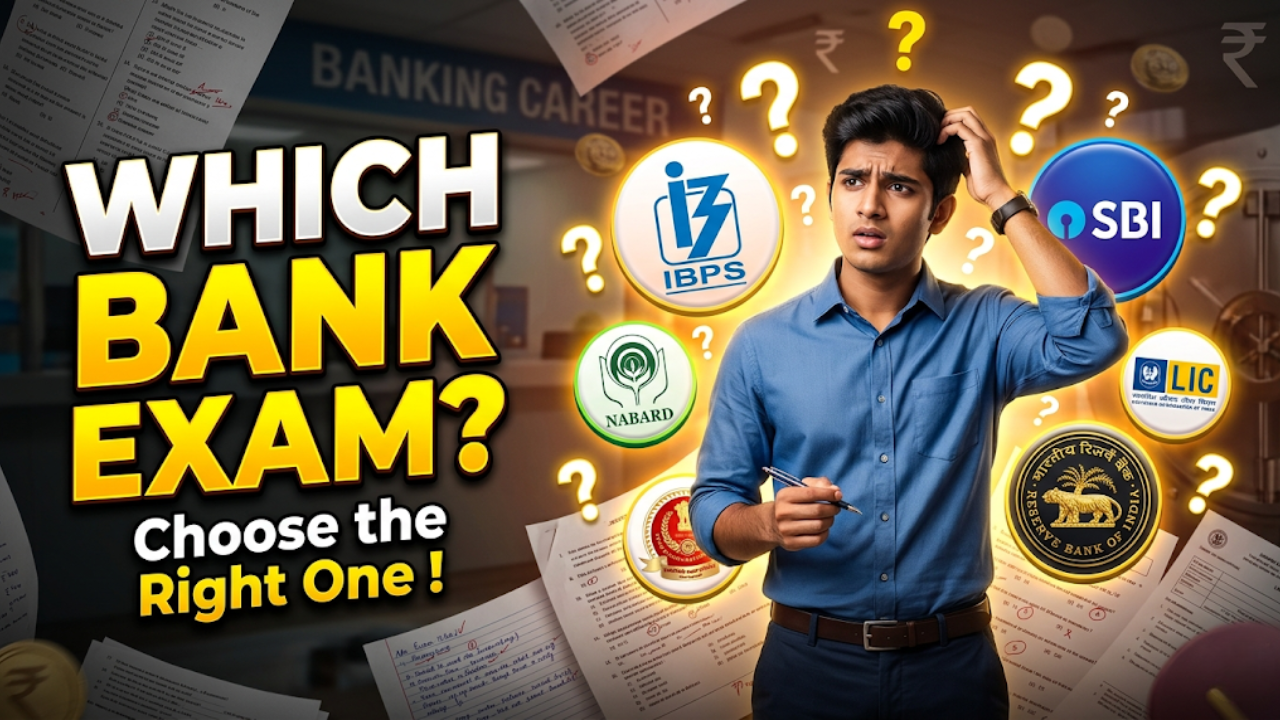
IBPS (Institute of Banking Personnel Selection)
IBPS is the largest banking recruitment body in India, conducting exams for 11+ public sector banks simultaneously. Its major exams are:
- IBPS Clerk: For clerical-grade roles across member banks
- IBPS PO: For Probationary Officer roles across member banks
- IBPS SO: For Specialist Officer roles across various verticals
- IBPS RRB Officer Scale I/II/III: For officer-level posts in Regional Rural Banks
- IBPS RRB Office Assistant: For clerical posts in Regional Rural Banks
A single IBPS score qualifies you for multiple banks simultaneously — a major advantage over individual bank exams.
SBI (State Bank of India)
SBI recruits independently and does not participate in IBPS. SBI PO is widely regarded as the most prestigious entry-level banking exam in India, and competition reflects that. SBI Clerk is similarly competitive. SBI also releases its own Specialist Officer and Circle Based Officer (CBO) notifications periodically.
RBI (Reserve Bank of India)
RBI conducts separate exams for Grade B Officers and RBI Assistants. RBI Grade B, in particular, has a three-phase selection process (Prelims, Mains, and Interview) and is considered one of the toughest and most rewarding banking exams in the country.
NABARD (National Bank for Agriculture and Rural Development)
NABARD recruits Grade A and Grade B officers for its development banking operations. The exam has a distinct syllabus with emphasis on agriculture, rural development, and economic analysis.
Salary Structure – What You Actually Earn
This is where most discussions about banking careers get muddled. People quote basic pay numbers and compare them unfairly to gross private sector CTC figures. Here is a transparent, structured breakdown of what banking salaries look like in 2026.
IBPS Clerk / Customer Service Associate
- Basic Pay: ₹24,050 per month (starting)
- Gross Salary (with DA, HRA, Special Allowance): ₹46,000–₹47,000 per month
- In-Hand (after deductions): ₹39,000–₹43,000 per month depending on city of posting
- Metro Advantage: Higher HRA in Mumbai, Delhi, Kolkata (partially offset by higher rent)
- Rural Posting: Lower HRA but also significantly lower cost of living
IBPS PO / Probationary Officer
- Basic Pay: ₹36,000–₹48,480 per month (varies by bank and advance increments)
- Gross Salary (with all allowances): ₹57,000–₹90,000 per month
- In-Hand (after deductions): ₹52,000–₹76,000 per month
- Total Effective Compensation (including benefits): ₹10–12 lakh per annum equivalent
Punjab & Sind Bank LBO (2026 Notification)
- Pay Scale: ₹48,480–₹85,920 per month
- Allowances: DA, HRA, Medical, and other benefits as per industry norms
SBI PO
- Basic Pay: ₹41,960 per month (starting)
- Gross Salary: ₹65,000–₹75,000 per month (including DA, HRA, and allowances)
- In-Hand: ₹55,000–₹65,000 per month
RBI Grade B Officer
- Basic Pay: ₹55,200 per month (starting)
- Gross Salary: ₹1,00,000–₹1,10,000+ per month with all allowances
- This is widely considered the best-paying entry-level banking exam in India
RBI Assistant
- Basic Pay: ₹29,000 per month (recently revised)
- Gross Salary: ₹47,000–₹52,000 per month
IBPS RRB Officer Scale I
- Basic Pay: ₹36,000–₹47,600 per month
- Gross Salary: ₹50,000–₹65,000 per month (varies by state and RRB)
Non-Monetary Benefits – The Part Most Candidates Undervalue
A banking salary comparison that ignores benefits is misleading. Public sector bank employees receive a comprehensive benefits package that, when monetised, substantially increases their total compensation:
- HRA (House Rent Allowance): 7%–9% of basic pay in rural areas; up to 15%–24% in metro cities
- DA (Dearness Allowance): Updated quarterly based on CPI index; currently over 40% of basic pay for most banks
- Medical Benefits: Hospitalisation and OPD coverage for self and family; reimbursement schemes are generous
- Leave Travel Concession (LTC): Subsidised travel for annual leave
- Pension / NPS: National Pension System contributions from both employee and employer
- Staff Loan Benefits: Home loans, car loans, personal loans at significantly concessional interest rates — this alone represents substantial real-world savings over a career
- Defined Promotions: Unlike private sector roles where promotion depends on manager discretion, banking promotions follow a structured internal examination and seniority system
The Selection Process – Step by Step
For most public sector bank exams, the selection process follows a three-tier structure:
Stage 1: Preliminary Examination
- Objective-type MCQ paper
- Sections typically include: English Language, Quantitative Aptitude, and Reasoning Ability
- Duration: 60 minutes (composite) or sectioned
- Qualifying in nature — shortlists candidates for Mains
Stage 2: Main Examination
- More detailed and lengthier paper
- For PO: Includes Reasoning & Computer Aptitude, Data Analysis, General/Economy/Banking Awareness, English Language, and a Descriptive Paper (Essay + Letter Writing)
- For Clerk: Similar but without descriptive component
- Marks carry significant weight in final merit list
Stage 3: Interview (PO and SO only)
- Applies to officer-grade recruitment
- Assesses personality, communication, awareness of banking and current affairs, and situational judgment
- Final merit: 80% Mains + 20% Interview (for most IBPS PO and SBI PO selections)
Local Language Proficiency Test
- Applicable for certain bank-specific recruitments (e.g., Punjab & Sind Bank LBO 2026)
- Candidates who studied the local language at Class 10 or 12 level are typically exempted
Career Growth – Where Banking Can Take You
One of the most underappreciated aspects of a banking career is its structured upward mobility. Unlike many private sector roles where career growth can stall without the right manager or the right business environment, public sector banks offer defined internal promotion pathways:
Clerk → Officer (JMGS-I): Through internal written examination after completing mandatory service years
Officer (JMGS-I) → Manager (MMGS-II): Typically within 3–5 years of confirmation
Manager → Senior Manager → Chief Manager → AGM → DGM → GM → ED → MD & CEO: Each step follows internal examination and performance review processes
Many of today’s General Managers and Executive Directors of leading public sector banks started as clerks or POs two to three decades ago. The career arc in banking is long, but it is dependable and genuinely rewarding for those who invest in it seriously.
Preparation Strategy for Banking Exams
Getting into a bank job requires structured, consistent preparation. Here is a reliable roadmap:
1. Know Your Exam: Study the official syllabus for the specific exam you are targeting. IBPS PO syllabus differs from SBI PO in emphasis and pattern. Do not prepare blindly.
2. Build Your Core Skills First: Every banking exam tests the same three domains — Quantitative Aptitude, Reasoning Ability, and English Language. Spend the first two to three months strengthening fundamentals in all three before moving to mock tests.
3. Current Affairs Is Non-Negotiable: Banking Awareness and General Awareness sections require you to track RBI monetary policy, budget announcements, major bank mergers, financial inclusion initiatives, and economic news. Read one financial daily or use a trusted current affairs app daily.
4. Take Regular Mock Tests: Mock tests are the single most effective preparation tool. They simulate exam conditions, expose your weak areas, and build time management skills. Aim for at least 30–40 full-length mocks before the real exam.
5. Analyse Your Mistakes Ruthlessly: A mock test only helps if you spend as much time analysing wrong answers as you do taking the test. Identify patterns in your errors and address them specifically.
6. Apply to Multiple Exams: Apply for IBPS Clerk, IBPS PO, SBI Clerk, SBI PO, and RBI Assistant simultaneously if eligible. Each exam is an opportunity. Do not put all your eggs in one basket.
Is a Banking Career Right for You? Honest Considerations
Before committing to a banking career, here are some realities worth acknowledging:
Transfers are inevitable. Especially at the PO level, you can be posted anywhere within the bank’s operating geography — which may mean small towns, different states, or locations far from family. Clerk transfers are less frequent and usually within the same state, but still possible. If you are firmly rooted to one city and cannot consider relocation, factor this in honestly.
The competition has intensified. The number of candidates taking banking exams grows every year, and average preparation levels have risen sharply. Cut-offs that would have qualified in 2019 may not clear prelims in 2026 for general category candidates. Serious, structured preparation is essential — casual preparation is unlikely to be sufficient.
Banking hours are largely predictable. Unlike IT or sales roles with unpredictable late nights or weekend work, banking largely follows branch hours. This is a major quality-of-life advantage for many people.
The work itself is process-driven. If you thrive on variety, creativity, and autonomy, a standard branch banking role may not satisfy you long-term. Specialist Officer and RBI Grade B roles offer more intellectual engagement. Understand what kind of environment energises you before choosing your target.
Quick Reference Summary
| Role | Qualification | Age Limit | Approx. In-Hand Salary |
|---|---|---|---|
| IBPS Clerk | Any Graduate | 20–28 years | ₹39,000–₹43,000/month |
| IBPS PO | Any Graduate | 20–30 years | ₹52,000–₹76,000/month |
| SBI PO | Any Graduate | 21–30 years | ₹55,000–₹65,000/month |
| SBI Clerk | Any Graduate | 20–28 years | ₹40,000–₹45,000/month |
| RBI Assistant | Any Graduate | 20–28 years | ₹45,000–₹50,000/month |
| RBI Grade B | Graduate (60%) | 21–30 years | ₹90,000–₹1,00,000/month |
| IBPS RRB Officer | Any Graduate | 18–30 years | ₹50,000–₹65,000/month |
| Punjab & Sind LBO | Graduate + 18 months exp. | 21–35 years | ₹48,480–₹85,920/month |
Final Word
A banking career in India is not glamorous in the startup sense. It does not promise overnight wealth or viral LinkedIn posts about equity exits. What it does promise — and reliably delivers — is a career built on genuine stability, dignified compensation, meaningful work, and social respect that compounds quietly over decades.
If you are a graduate between 20 and 30 years of age, the window you have right now is exactly the right time to make this choice. The exams are challenging but passable with structured preparation. The jobs, once secured, are among the most secure in the country.
Do your research, verify the latest notifications on official portals, prepare with intention, and apply across multiple exams to maximise your chances. The banking sector has room for lakhs of talented, hardworking individuals — and in 2026, it is actively recruiting.
For the latest updates on banking exam notifications, admit cards, results, and salary revisions, always refer to official bank websites and the IBPS portal at ibps.in.
Disclaimer: Salary figures are based on publicly available information as of April 2026 and may vary based on bank, location, and applicable allowances. Always verify current figures from official recruitment notifications before making career decisions.
Bank Jobs in India 2026: Complete Career Guide
Every year, millions of graduates across India prepare for one goal: securing a bank job. In a country where stability, consistent income, and long-term security matter, the banking sector continues to be one of the most trusted career choices.
If you are planning to enter this field, this guide covers everything — salary, eligibility, exams, and career growth.
Why Banking Jobs Are Popular in India
Banking jobs offer a unique combination of job security, stable income, benefits, and social respect. Unlike private jobs, salaries are credited on time, layoffs are rare, and employees receive pensions, medical benefits, and allowances.
A Probationary Officer can earn up to ₹10–12 lakh annually including benefits, making it one of the most rewarding government careers.
Types of Bank Jobs in India
1. Clerk: Entry-level role handling customer transactions and account services.
2. Probationary Officer (PO): Manages operations, loans, and team responsibilities.
3. Specialist Officer (SO): Roles in IT, Law, HR, Marketing, and Finance.
4. RRB Jobs: Focus on rural banking with Officer and Assistant roles.
5. RBI Jobs: Includes RBI Grade B and Assistant, considered top-tier roles.
Eligibility Criteria for Bank Jobs
| Role | Qualification | Age Limit |
|---|---|---|
| Clerk | Graduate (Any Stream) | 20–28 Years |
| PO | Graduate (Any Stream) | 20–30 Years |
| RBI Grade B | Graduate (60%) | 21–30 Years |
| Specialist Officer | Relevant Degree | 20–30 Years |
Bank Job Salary in India 2026
| Role | In-Hand Salary |
|---|---|
| IBPS Clerk | ₹39,000–₹43,000/month |
| IBPS PO | ₹52,000–₹76,000/month |
| SBI PO | ₹55,000–₹65,000/month |
| RBI Grade B | ₹90,000–₹1,00,000+/month |
Top Banking Exams in India
The major banking exams include IBPS PO, IBPS Clerk, SBI PO, SBI Clerk, and RBI Grade B. These exams test reasoning, quantitative aptitude, English, and current affairs.
IBPS exams allow candidates to apply for multiple banks with a single score, increasing selection chances.
Selection Process
Prelims: Basic screening test.
Mains: Detailed exam with higher difficulty.
Interview: For officer-level posts.
Final selection is based on performance in mains and interview.
Why You Should Choose Banking Career
Banking offers long-term stability, structured promotions, fixed working hours, and financial security. It is ideal for candidates looking for a balanced and secure career.
FAQs
1. What is the salary of bank jobs in India?
Bank salaries range from ₹39,000 to ₹1,00,000+ per month depending on the role.
2. Which is the best banking exam?
RBI Grade B is the most prestigious, followed by SBI PO and IBPS PO.
3. Can freshers apply for bank jobs?
Yes, any graduate can apply for clerk and PO exams.
4. Is banking a good career in 2026?
Yes, due to job security, benefits, and career growth.
5. How to prepare for bank exams?
Focus on basics, practice mock tests, and stay updated with current affairs.
Recommended:
- CRPF Constable Tradesman Recruitment 2026: Apply Online for 9195 Posts, Check Eligibility & Last Date
- How to Get a Job in USA from India (2026 Guide) – Visa, Salary & Strategy
- AP Inter Results 2026 Date (Out Soon): Check BIEAP 1st & 2nd Year Result @ bie.ap.gov.in
- Top Career Options After Graduation in India 2025 | Best Jobs & Future Scope
- India Post Skilled Artisan Recruitment 2026: Apply Offline for 11 Posts, 8th Pass Job Opportunity